
Building your own garden gym doesn’t have to be complicated or expensive. With the right space, suitable timber and the right outdoor gym equipment, you can create a permanent workout area that’s designed around your garden and the people who will use it.

Start by Deciding Who Will Use the Gym
Before choosing your equipment, think about who the garden gym is going to be for.
Is it mainly for adults, for children, or will it be a family gym used by everyone?
For adults, you might want equipment for pull-ups, dips, hanging exercises, calisthenics and general strength training.
If children will be using it too, equipment such as monkey bars, climbing ladders and roll-over bars can make the gym much more enjoyable for them.
If it’s going to be a family gym, you can combine both. This is one of the advantages of building your own garden gym — you can choose the equipment around the people who will actually use it, rather than buying a standard gym package.
It’s also worth thinking about how your needs might change. Children grow, your training may change, and you may want to add more equipment later. Designing the gym with future additions in mind can save you having to start again.
Decide What You Want to Train
Once you know who will be using the gym, think about what you actually want to do with it.
For adults, that could include:
- Pull-ups and chin-ups
- Dips
- Hanging exercises
- Calisthenics
- Bodyweight training
- General strength and fitness
For children, the focus may be more on climbing, hanging, swinging and developing strength and coordination.
You don’t need to buy everything at once. Start with the equipment that will get the most use and add to the gym as you go.
How Much Space Do You Have?
The amount of space available in your garden will help determine what you can build.
A single pull-up bar needs very little space compared with a larger multi-station garden gym.
Measure the area you have available and think about:
- The footprint of the structure
- The height of the equipment
- Space around the equipment
- Room to move while exercising
- Clearance above and around the equipment
- Whether you might want to add more equipment later
It is much easier to plan this before you start digging.
You Don’t Need a Shed or Summer House
A garden gym doesn’t have to be inside a shed, summer house or garden room.
An open outdoor gym can give you everything you need for bodyweight and strength training while keeping the garden feeling open.
There is also a big advantage to having the equipment outside. You can simply walk out into the garden and train, rather than having to convert a room or build an enclosed structure.
For many people, a simple timber structure with outdoor gym equipment is all that’s needed.
Choose the Right Timber
The timber posts are an important part of the structure. This is also why our gyms are often rectangular/square. The more bars the stronger the frame.
Outdoor gym equipment can be subjected to considerable forces when people are pulling, swinging, climbing and exercising on it, so you need substantial posts rather than lightweight garden timber.
The way the posts are installed into the ground is just as important as the size of the posts.
It’s also worth protecting the timber around ground level, where it is exposed to moisture. Postsavers can help protect the bottom section of the timber and are included with Xorbars DIY kits.
Choose Your Equipment
Once you’ve worked out who will use the gym, what they want to do and how much space you have, you can start choosing the equipment.
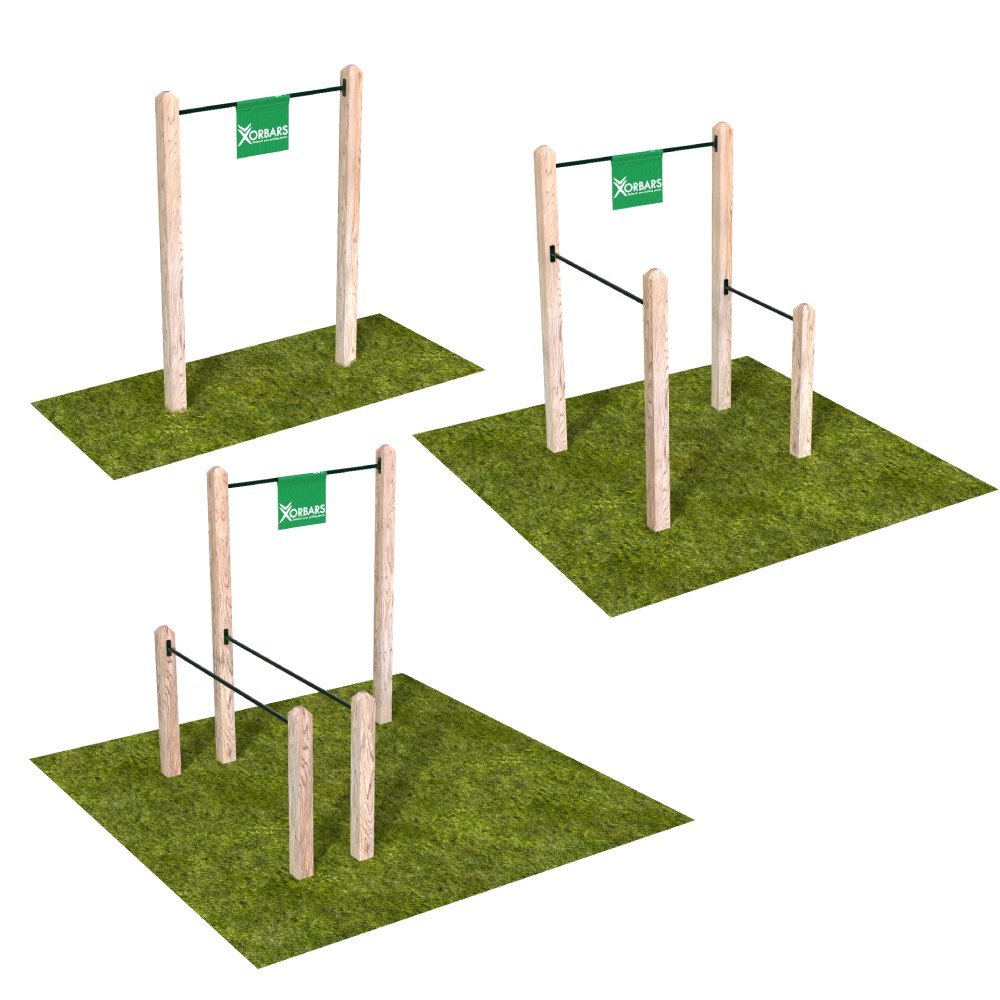
For an adult-focused gym, a pull-up bar and dip bars can provide a surprisingly large range of exercises.
For a family gym, you could add equipment such as:
- Monkey bars
- Climbing ladders
- Roll-over bars
- Additional pull-up bars
- Dip bars
- Other climbing and bodyweight equipment
You don’t need to create the finished gym in one go. A good DIY system can allow you to start with the essentials and add equipment later.
Think About Height
One of the biggest advantages of an outdoor gym is the height you can achieve.
A typical UK ceiling is around 2.4m, which can make indoor pull-up bars restrictive, particularly for taller users or exercises where you want more room.
Outside, you can position your equipment at a suitable height and have much more
What Surface Should You Use?
You don’t necessarily need an expensive gym floor.
Grass can be a great option for an outdoor gym and gives it a natural feel. It’s particularly nice if you like training outside barefoot.
For wetter conditions, bark chippings or rubber bark chippings can be useful around the gym and are less likely to become a muddy mess than bare soil.
The right surface depends on the equipment you are installing and how you intend to use it.
Where there is a risk of falling from equipment, make sure the surface is appropriate for the activity and equipment being used.
Think About the Installation
A DIY garden gym doesn’t necessarily require a specialist installer.
If you’re comfortable with basic DIY, digging, installing timber posts and assembling equipment, a straightforward garden gym can be a manageable project.
Xorbars DIY kits are designed to make installation as straightforward as possible, with support available if you need it.
If you don’t want to do it yourself, a local handyman, landscaper or builder should be able to install a straightforward setup.
The important thing is that the structure and equipment are installed securely and correctly.
Build It in Stages
One of the biggest advantages of building your own garden gym is that you don’t have to buy everything at once.
You could start with a pull-up bar, then add dip bars or monkey bars later.
This can make the project more affordable and also means you can see which equipment gets used most before expanding the gym.
If you think you might add equipment in the future, consider this when planning the initial structure and layout.
DIY or Professionally Installed?
Building the gym yourself can save money and gives you complete control over the final setup.
It also means you can build it around your own garden rather than adapting your garden to a pre-designed gym.
However, DIY doesn’t mean you have to work everything out yourself. Choosing equipment from a company that provides installation guidance and support can make the process much easier.
Alternatively, you can simply buy the equipment and have a local tradesperson install it for you.
How Difficult Is It?
For a competent DIYer, building a straightforward garden gym is not necessarily a difficult project.
The basic process is:
- Decide who will use the gym.
- Decide what you want to train.
- Measure and plan the available space.
- Choose your timber and equipment.
- Plan where the posts and equipment will go.
- Install the structure securely.
- Assemble the equipment.
- Check everything carefully before use.
The exact installation will depend on the equipment and design you’ve chosen.
For more detailed information about installing individual Xorbars products, see our DIY Help Hub.
Build Your Own Outdoor Garden Gym
The great thing about a DIY garden gym is that you can make it exactly what you need.
It could be a simple pull-up station for one person, a larger training area for adults, or a family gym with climbing and monkey-bar equipment for children as well.
You don’t need to build everything at once. Start with the equipment you’ll use most, plan for the future and build your gym around your garden.